> For the complete documentation index, see [llms.txt](https://protegejj.gitbook.io/algorithm-practice/llms.txt). Markdown versions of documentation pages are available by appending `.md` to page URLs; this page is available as [Markdown](https://protegejj.gitbook.io/algorithm-practice/leetcode/heap/973.-k-closest-points-to-origin.md).
# 973. K Closest Points to Origin
## 973. [K Closest Points to Origin](https://leetcode.com/problems/k-closest-points-to-origin/)
## 1. Question
Given an array of `points` where `points[i] = [xi, yi]` represents a point on the **X-Y** plane and an integer `k`, return the `k` closest points to the origin `(0, 0)`.
The distance between two points on the **X-Y** plane is the Euclidean distance (i.e., `√(x1 - x2)2 + (y1 - y2)2`).
You may return the answer in **any order**. The answer is **guaranteed** to be **unique** (except for the order that it is in).
**Example 1:**
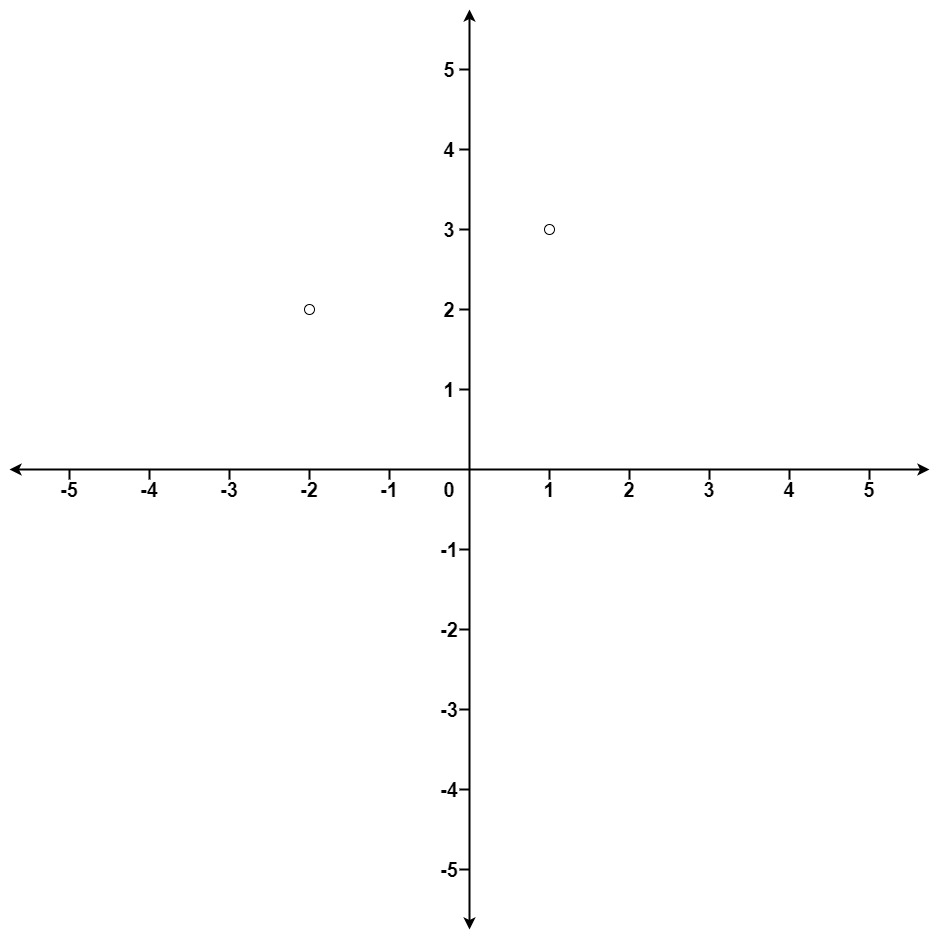
Input: points = [[1,3],[-2,2]], k = 1
Output: [[-2,2]]
Explanation:
The distance between (1, 3) and the origin is sqrt(10).
The distance between (-2, 2) and the origin is sqrt(8).
Since sqrt(8) < sqrt(10), (-2, 2) is closer to the origin.
We only want the closest k = 1 points from the origin, so the answer is just [[-2,2]].
**Example 2:**
Input: points = [[3,3],[5,-1],[-2,4]], k = 2
Output: [[3,3],[-2,4]]
Explanation: The answer [[-2,4],[3,3]] would also be accepted.
**Constraints:**
* `1 <= k <= points.length <= 104`
* `-104 <= xi, yi <= 104`
## 2. Implementation
**(1) Heap**
```python
class Solution:
def kClosest(self, points: List[List[int]], k: int) -> List[List[int]]:
pq = []
for x, y in points:
dist = -(x*x + y*y)
if len(pq) == k:
heapq.heappushpop(pq, (dist, x, y))
else:
heapq.heappush(pq, (dist, x, y))
return [(x, y) for (dist, x, y) in pq]
```
## 3. Time & Space Complexity
**Heap:** 时间复杂度O(n \* log(k)), 空间复杂度O(k)